
L’artista
Antonio Hase
Antonio Hase va néixer el 1963 a la Bòsnia occidental amb el cognom Draganović. L’any 1984 va arribar a Hamburg, després va viure a Lucerna i des d’aleshores viu i treballa a Munic. Artista d’una versatilitat notable — pintor, novel·lista, guionista, actor i director —, fa més de quaranta anys que es dedica a les arts visuals.
Participa en exposicions col·lectives des del 1985 i en individuals des del 1986 — fins ara n’ha fet deu d’individuals. Les seves obres es troben en col·leccions privades d’Alemanya, Suïssa, el Canadà, Croàcia i els Estats Units. Com a pintor croata-alemany, els darrers anys ha assolit un reconeixement internacional creixent.
La seva pintura arrela en l’abstracció — una opció que va prendre forma a mitjans dels anys vuitanta gràcies a l’amistat amb Vlado Kristl, que el va introduir en el món de l’abstracció i el va presentar al gran pintor alemany de l’informalisme Emil Schumacher. Al llarg de quatre dècades de treball, del constructivisme al deconstructivisme, s’ha consolidat com a pioner del deconstructivisme en la pintura.
Inspirations and dedications – Emil Schumacher, Vlado Kristl and Antonio Hase
"The motif of my painting is always a dedication to Schumacher and Kristl."
Antonio Hase's artistic path was shaped by encounters with great names of world art. As early as the eighties, his friend Vlado Kristl introduced him to the German painter Emil Schumacher. That meeting left a deep mark on Hase, awakening a profound bond with abstract expression to which he has remained faithful ever since.
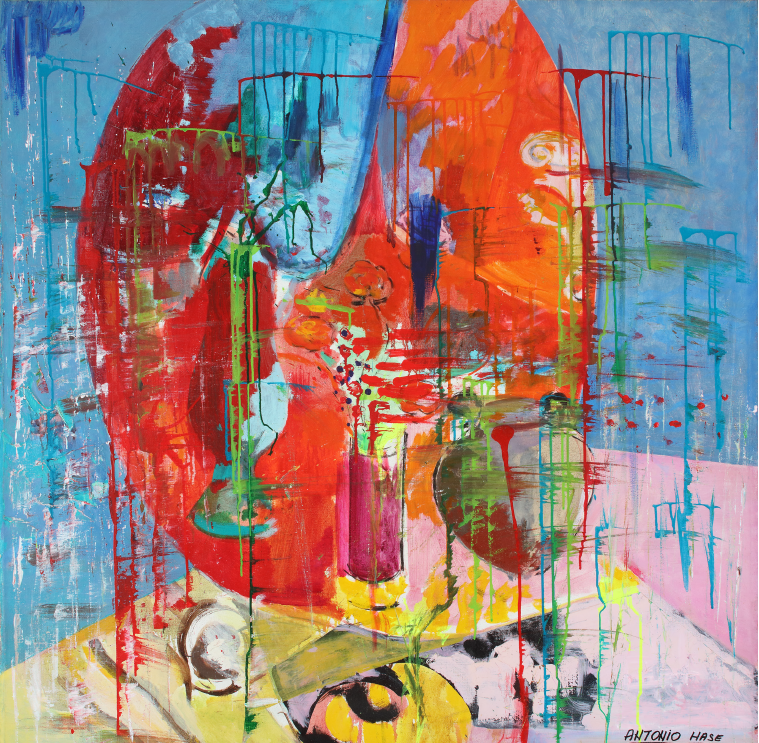
At that meeting Hase promised Schumacher that he would follow his path and devote himself to abstraction. Although both Schumacher and Kristl have since passed away, their presence lives on strongly in Hase's work. He turned their legacy into one of his significant works – a painting with the motif of a monument and an urn as a symbolic dedication to Schumacher, while scattered flower petals fall onto the urn in memory of Vlado Kristl.
Hase explains that the petals of Kristl's flowers also carry a personal meaning – they stand for the moment Kristl introduced him to Schumacher. The painting was exhibited and drew great interest, although at the time the artist had no chance to speak about its meaning in detail. Today he wants to share that story and show the deeply personal dimension of his work.
With these works Antonio Hase not only keeps the memory of his friends and mentors alive, but shows that art can be a bridge between generations and a lasting message of gratitude.