
L’artiste
Antonio Hase
Antonio Hase est né en 1963 en Bosnie occidentale sous le nom de Draganović. Arrivé à Hambourg en 1984, puis à Lucerne, il vit et travaille depuis à Munich. Artiste d’une grande polyvalence — peintre, romancier, scénariste, acteur et réalisateur — il consacre depuis plus de quarante ans son travail aux arts visuels.
Il participe à des expositions collectives depuis 1985 et à des expositions personnelles depuis 1986, avec dix expositions individuelles à son actif. Ses œuvres figurent dans des collections privées en Allemagne, en Suisse, au Canada, en Croatie et aux États-Unis. Peintre croato-allemand, il gagne ces dernières années une reconnaissance internationale croissante.
Sa peinture est enracinée dans l’abstraction — un engagement né au milieu des années 1980 de son amitié avec Vlado Kristl, qui l’introduisit au monde de l’abstraction et lui fit rencontrer le grand peintre informel allemand Emil Schumacher. En quatre décennies de travail, du constructivisme au déconstructivisme, il s’est imposé comme un pionnier du déconstructivisme en peinture.
Inspirations and dedications – Emil Schumacher, Vlado Kristl and Antonio Hase
"The motif of my painting is always a dedication to Schumacher and Kristl."
Antonio Hase's artistic path was shaped by encounters with great names of world art. As early as the eighties, his friend Vlado Kristl introduced him to the German painter Emil Schumacher. That meeting left a deep mark on Hase, awakening a profound bond with abstract expression to which he has remained faithful ever since.
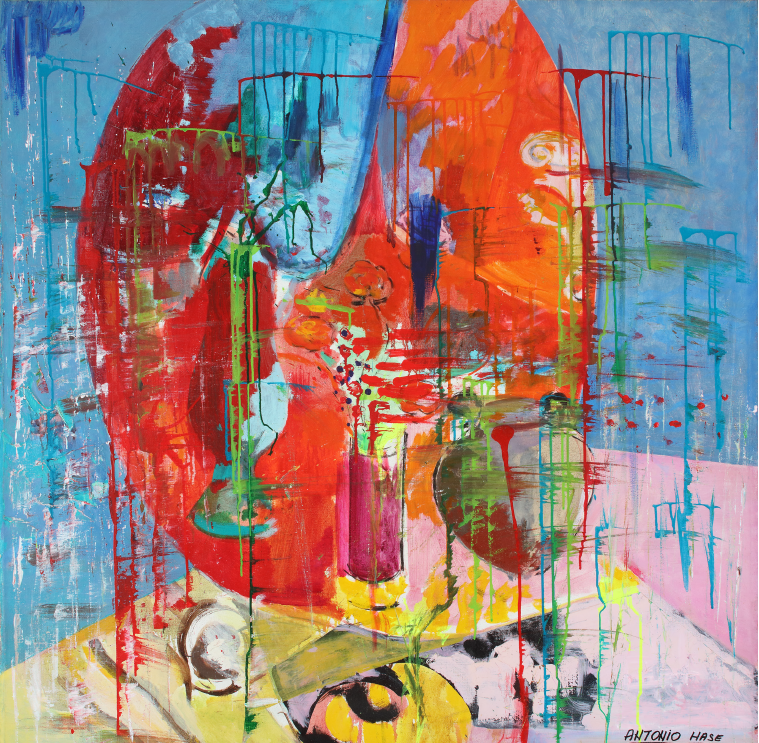
At that meeting Hase promised Schumacher that he would follow his path and devote himself to abstraction. Although both Schumacher and Kristl have since passed away, their presence lives on strongly in Hase's work. He turned their legacy into one of his significant works – a painting with the motif of a monument and an urn as a symbolic dedication to Schumacher, while scattered flower petals fall onto the urn in memory of Vlado Kristl.
Hase explains that the petals of Kristl's flowers also carry a personal meaning – they stand for the moment Kristl introduced him to Schumacher. The painting was exhibited and drew great interest, although at the time the artist had no chance to speak about its meaning in detail. Today he wants to share that story and show the deeply personal dimension of his work.
With these works Antonio Hase not only keeps the memory of his friends and mentors alive, but shows that art can be a bridge between generations and a lasting message of gratitude.