
An t-ealaíontóir
Antonio Hase
Rugadh Antonio Hase sa bhliain 1963 in iarthar na Boisnia faoin sloinne Draganović. Tháinig sé go Hamburg sa bhliain 1984, chónaigh sé i Lucerne ina dhiaidh sin, agus ó shin i leith tá cónaí agus obair air i München. Ealaíontóir thar a bheith ildánach — péintéir, úrscéalaí, scríbhneoir scáileáin, aisteoir agus stiúrthóir — tá breis is daichead bliain caite aige i mbun na n-amharcealaíon.
Tá páirt glactha aige i dtaispeántais ghrúpa ó 1985 agus i dtaispeántais aonair ó 1986 — deich gcinn go dtí seo. Tá a chuid saothar i mbailiúcháin phríobháideacha sa Ghearmáin, san Eilvéis, i gCeanada, sa Chróit agus sna Stáit Aontaithe. Mar phéintéir Cróitis-Gearmánach, tá aitheantas idirnáisiúnta níos leithne á fháil aige le blianta beaga anuas.
Tá a chuid péintéireachta fréamhaithe sa teibíocht — rogha a cruthaíodh i lár na n-ochtóidí trína chairdeas le Vlado Kristl, a threoraigh isteach i saol na teibíochta é agus a chuir in aithne dó an péintéir mór Gearmánach informel, Emil Schumacher. Thar cheithre scór bliain oibre, ón tógálachas go dtí an díthógálachas, tá sé bunaithe mar cheannródaí an dhíthógálachais sa phéintéireacht.
Inspirations and dedications – Emil Schumacher, Vlado Kristl and Antonio Hase
"The motif of my painting is always a dedication to Schumacher and Kristl."
Antonio Hase's artistic path was shaped by encounters with great names of world art. As early as the eighties, his friend Vlado Kristl introduced him to the German painter Emil Schumacher. That meeting left a deep mark on Hase, awakening a profound bond with abstract expression to which he has remained faithful ever since.
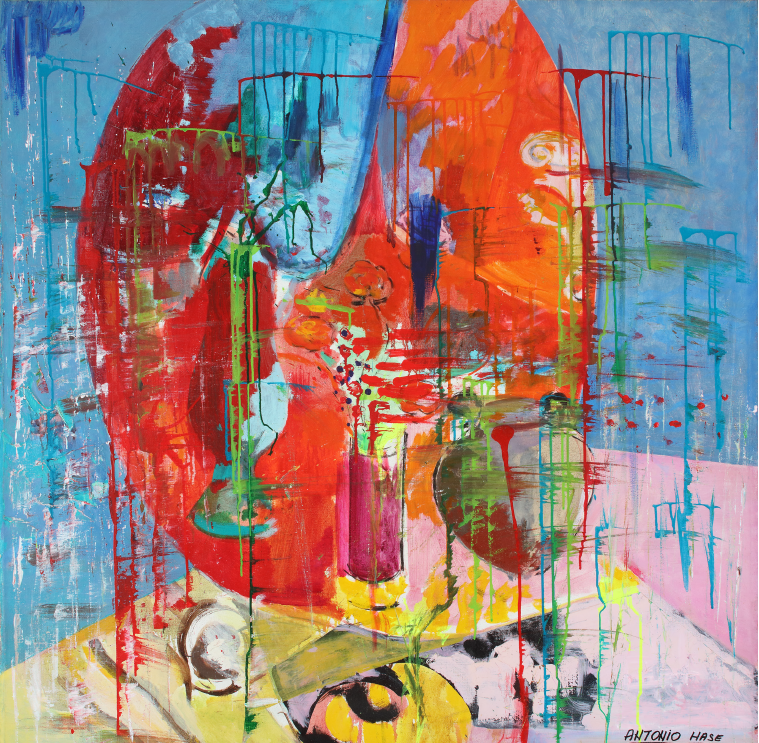
At that meeting Hase promised Schumacher that he would follow his path and devote himself to abstraction. Although both Schumacher and Kristl have since passed away, their presence lives on strongly in Hase's work. He turned their legacy into one of his significant works – a painting with the motif of a monument and an urn as a symbolic dedication to Schumacher, while scattered flower petals fall onto the urn in memory of Vlado Kristl.
Hase explains that the petals of Kristl's flowers also carry a personal meaning – they stand for the moment Kristl introduced him to Schumacher. The painting was exhibited and drew great interest, although at the time the artist had no chance to speak about its meaning in detail. Today he wants to share that story and show the deeply personal dimension of his work.
With these works Antonio Hase not only keeps the memory of his friends and mentors alive, but shows that art can be a bridge between generations and a lasting message of gratitude.